History of the RagaMuffin
From Ann Baker's Cherubims to the RagaMuffin, another branch of the family story.
The following account is largely based on "The History of the RagaMuffin", as told by Janet Klarmann, President of the RagaMuffin Associated Group (RAG), the RagaMuffin breed club. Her account focuses on the origins of the RagaMuffin breed.
Having personally taken part in the breed's early development, Janet provides a valuable first-hand account.
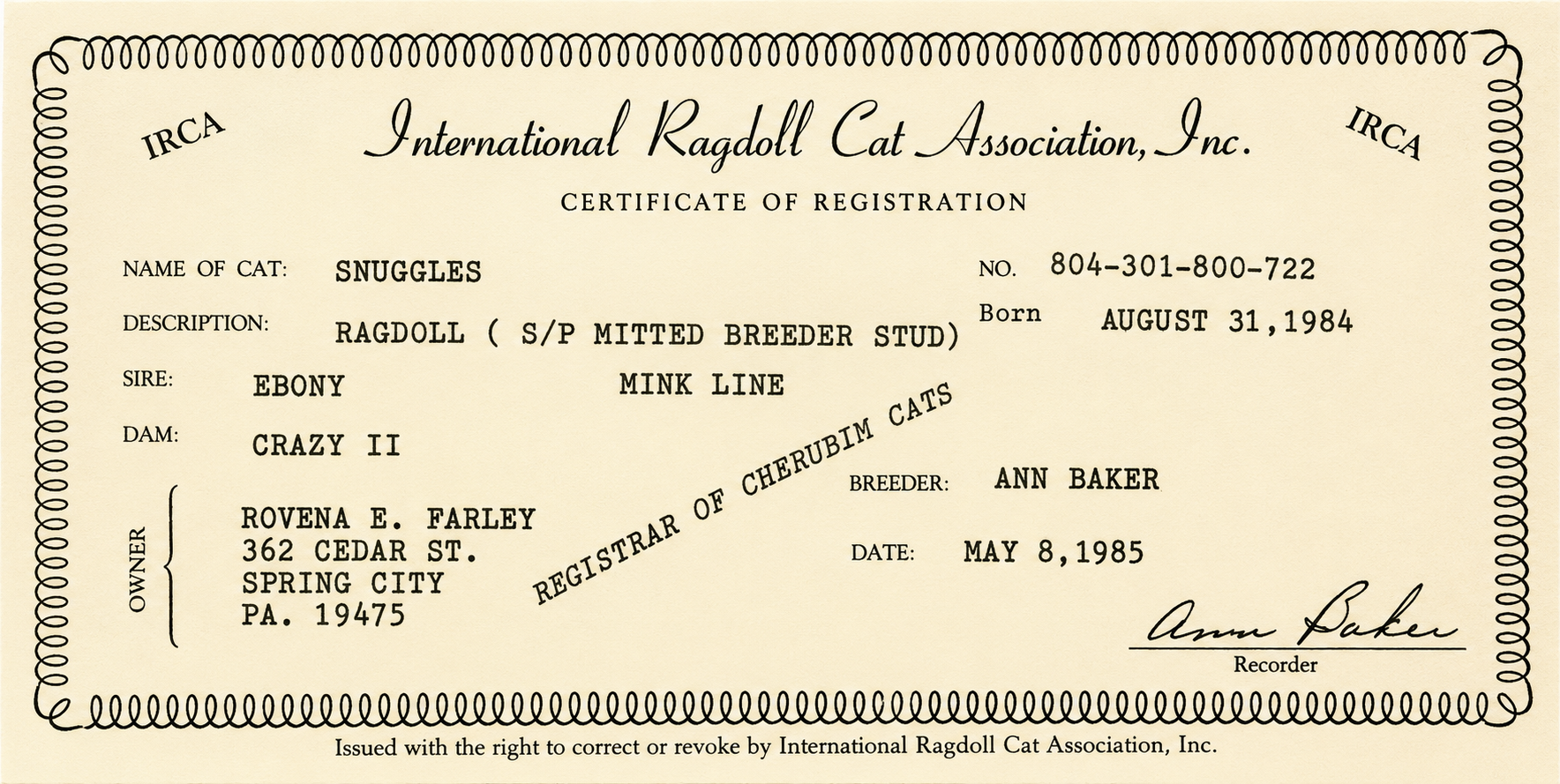
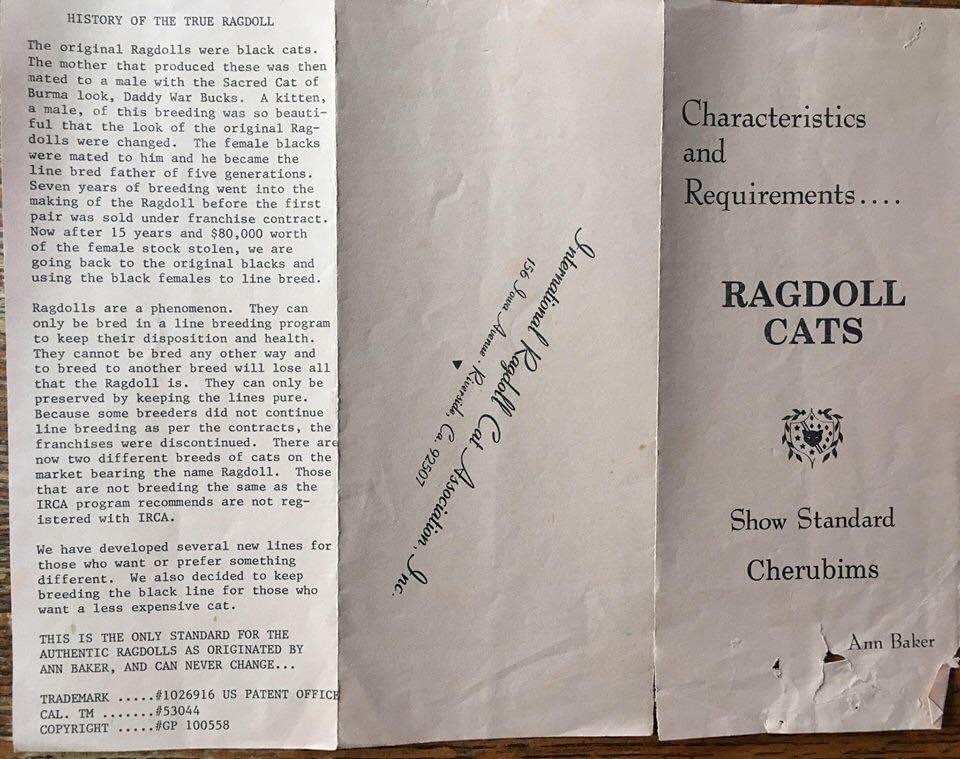
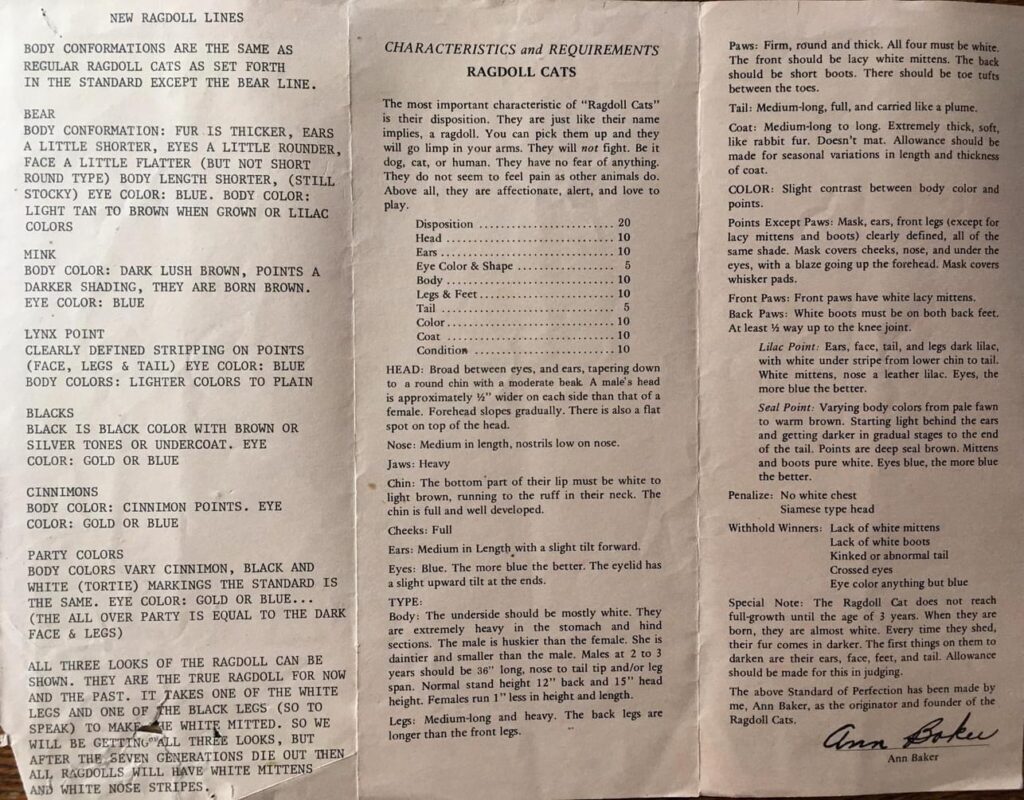
The history of the RagaMuffin is every bit as tangled as that of the Ragdoll. To understand it, we must once again return to Ann Baker and her Cherubims. "Cherubim" was the collective name Ann Baker used for all the breeds she developed: the Ragdoll, Miracle Ragdoll, Honey Bear, Little American, Baby Doll, Ragdoll Tu, and many others.
Of all these so-called "breeds" that she developed and registered with the IRCA, only the Ragdoll and the Honey Bear would ultimately survive. The RagaMuffin acquired its name only after its breeders broke away from Ann Baker's control. The breed itself descends from a mixture of the various Cherubim bloodlines.
A brief reminder of the beginning
Of all the controversies and theories surrounding the true origins of the breed, I shall retain only the episode in which Ann Baker and Mrs. Pennels began keeping Josephine's extraordinary kittens in order to launch a breeding programme that would eventually become the Cherubims.
After Josephine's accident, she was reportedly taken to a laboratory by the Pennels' sons, who worked there at the time. According to the story, the laboratory was researching methods of pain control, and it has often been suggested that experiments involving marijuana or other substances capable of altering genes may have been carried out—possibly influencing the characteristics of Josephine's future offspring.
Once she returned to the Pennels' home, her kittens were said to be large, affectionate, exceptionally friendly, completely relaxed when picked up and blessed with abundant, silky coats... true sweethearts, regardless of which male had sired the litter.
What really happened? Your guess is as good as mine.
Those who remained after the secession
IRCA-licensed breeders paid an annual breeding licence fee of $150, in addition to a 10% royalty on every kitten sold.
At the time, none of the breeders objected to this arrangement. It actually cost them less than paying for their own advertising.
Ann Baker had originally planned to hand ownership of the IRCA over to its licensed breeders on 1 January 1994, and they had ambitious plans to turn it into a strong and respected organisation.
They had even agreed that Ann would continue receiving royalties on kitten sales to provide her with a comfortable retirement income.
But Ann changed her mind. Sounds familiar, or ?
The Second Secession...
Once it became clear that control of the IRCA would never be transferred, a group of breeders met to explore every possible way of leaving both the IRCA and Ann Baker.
The only way to honour the agreements they had signed with Ann, while no longer using the name "Ragdoll" and continuing to breed their cats, was to register them as an entirely new breed under a different name.
It was Curt Gehm's idea to submit an application to the ACFA, and, to everyone's surprise, the breed was granted Experimental status.
Even before that meeting, the Castles had already begun preparing the groundwork. With the assistance of Winnie Keuller (ACFA), they drafted a new breed standard. At the same time, they entered every one of Ann Baker's pedigrees into a computer database, finally giving them accurate genealogical records for every cat included in their breeding programme.
According to Janet Klarmann, it was Curt Gehm, of Liebling Cats (Virginia), who suggested the name RagaMuffin. It referred to the little stray "ragamuffin" cats roaming the streets of Riverside, from which Ann Baker's first cats had originated. As for the capital M, Janet jokingly explained that it stood for the breed's "big, huggable, lovable Muffins."
While the group was deciding on a permanent name, the Castles temporarily adopted the name RagaMuffin, proposed by Curt Gehm of Liebling Cats (Virginia). It referred to Riverside's little stray cats, while the capital M humorously evoked those "big, huggable, lovable Muffins" and offered a playful nod to the surname of the breed's creator—Baker.
The name perfectly captured the image of an endearing little street urchin... and at the same time a delicious muffin. In short: a RagaMuffin.
That is how RagaMuffin officially became the name of the breed.
The RagaMuffin was therefore born in February 1994 from the cats owned by a small group of former IRCA breeders.
At the same time, the RagaMuffin Associated Group (RAG) was officially recognized by the ACFA as the breed club for the RagaMuffin.
The Founders of the RagaMuffin Breed
According to Janet Klarmann's testimony and the history of the RAG's foundation, the principal architects of the RagaMuffin breed included:
- Curt Gehm (GemsDolls), who initiated the creation of the new breed.
- Pat Flynn, deeply involved in the ACFA application and the breed's first exhibitions.
- Janet Klarmann, President of the RagaMuffin Associated Group, first-hand witness and spokesperson for the emerging breed.
- Richard and Anne Castle, authors of the first breed standard, responsible for computerising Ann Baker's pedigrees and helping establish the name RagaMuffin.
- Lisa Rowe.
- Pat Messner.
- Sonia Rolston.
- Becky von Stetten.
- Karen Hoffman.
- Laura Gregory, who notably supported the submission of the ACFA Championship application.
I would also like to give special recognition to Winnie Keuller, not as a founder of the RagaMuffin, but for guiding the breeders through the ACFA recognition process and assisting in the drafting of the breed standard.
And the adventure continued...
Little by little, thanks to the determination of this small group of breeders, Pat Flynn and Curt Gehm obtained permission to exhibit their cats as an Experimental Breed, paving the way for full recognition as a distinct breed.
The journey was anything but smooth. I still remember the epic debates between Curt Gehm and Jen Hansen on the early Ragdoll discussion forums. Jen firmly maintained that there was so little morphological difference between Ragdolls and RagaMuffins that recognising them as separate breeds was complete nonsense.
Happy Ending...
Did history ultimately prove her right? Through a series of rather unusual registration decisions—something for which TICA has become well known—the descendants of the RagaMuffins eventually became Cherubims after briefly passing through the category of non-pointed Ragdolls. They were finally incorporated into the Ragdoll Breed Group by TICA in 2025 and by LOOF in 2026.
Thirty years after the split, history seems to have come full circle.
Welcome home, dear cousins.